
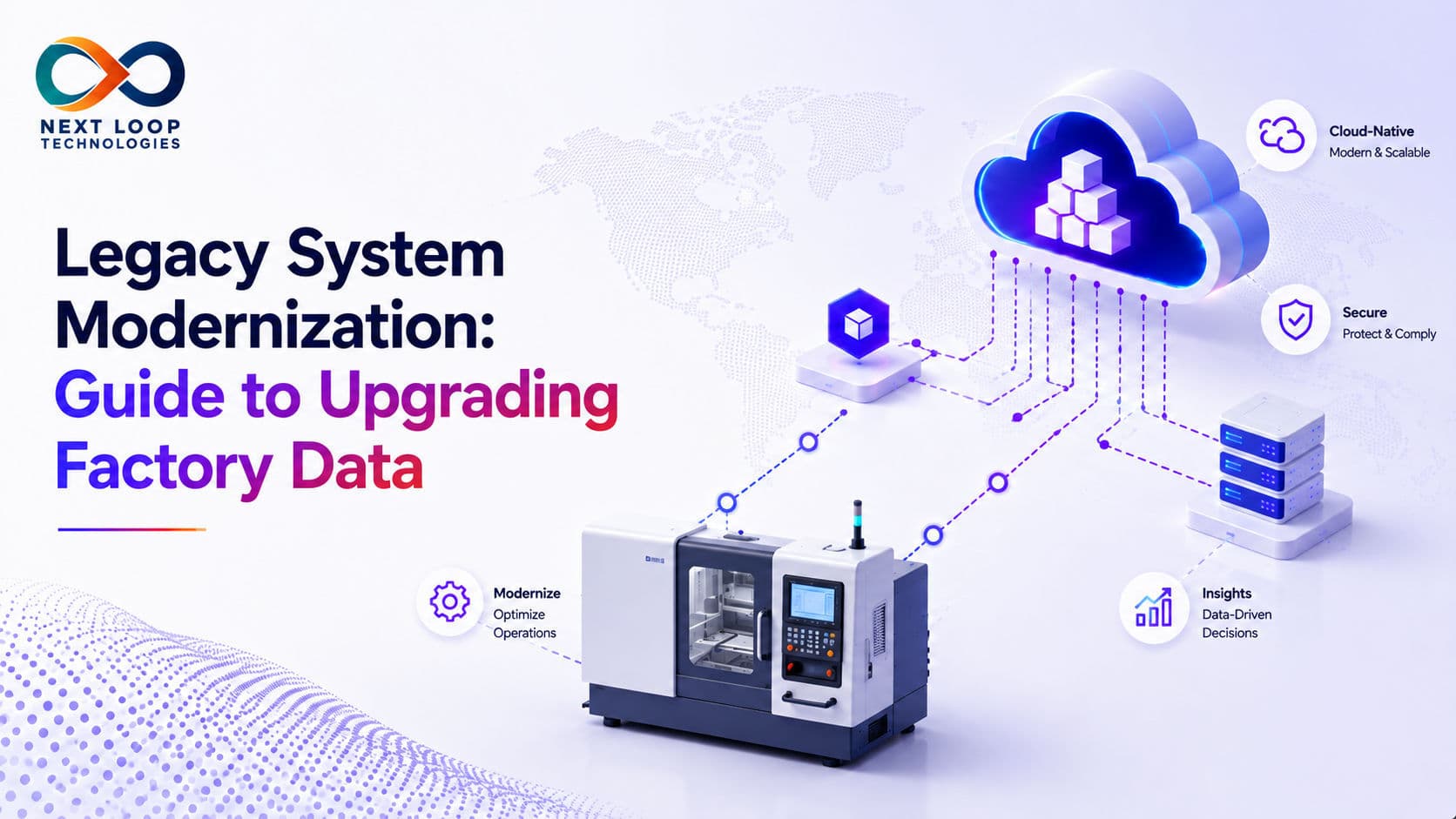
Legacy System Modernization: A Complete Guide to Upgrading Factory Data
The Author
Aditi Agrawal is an SEO Executive at Nextloop Technologies who writes about SEO, digital marketing, technology, and emerging trends in the digital landscape. Her work focuses on sharing practical, easy-to-understand insights to help businesses strengthen their online presence and visibility.
Factories and energy plants rely on massive heavy machinery. These industrial pumps, complex assembly lines, and high-pressure compressors were built to last for multiple decades. They are incredibly powerful and they perform their physical duties perfectly day after day.
However, they have one major problem that completely frustrates modern executive teams. They were never designed to connect to the modern internet.
When these machines were installed years ago, digital cloud servers did not exist. The machinery was built to operate in total isolation. This creates a massive digital blind spot for today's operations directors. When executives cannot see live production numbers, they are forced to make major business choices based on outdated spreadsheets.
Upgrading these older machines does not mean you have to throw them away. Legacy system modernization is the highly specialized process of connecting your existing physical equipment to modern web dashboards. You can keep your durable mechanical assets while completely upgrading your digital capabilities.
This detailed guide explains exactly how connecting legacy machinery to the cloud works safely efficiently and simply.
Read more: Microservices and Distributed Cloud-Native Applications: Evolution, Benefits, and Best Practices
The Hidden Costs of Aging Systems
What Is Legacy System Modernization?
Legacy system modernization is the process of connecting existing factory equipment, pumps, compressors, assembly lines, to modern cloud dashboards without replacing the physical machinery itself. It works by attaching sensors and edge devices that extract real-time data from equipment that was never originally built to share it.
Many factory directors hesitate to touch their older machinery because it is technically still working. However, waiting until a machine completely fails is a terrible business strategy. The physical machinery essentially traps the critical numbers inside the metal casing.
Operations directors face extreme financial risks when they ignore these five common reporting failures:
- Invisible Metrics: The only way to check machine health is by walking down to the factory floor to read a physical screen mounted directly on the metal casing.
- Slow Reporting: Executive teams wait days for manual data entry just to see the total weekly production volume.
- Wasted Labor: Highly skilled engineers spend their valuable time copying numbers onto paper clipboards instead of actually optimizing the machinery.
- Inventory Panic: Facilities stockpile millions of dollars in spare parts because they never know exactly what will break next.
- Compliance Penalties: Regulatory bodies require exact emissions and performance data which is impossible to track accurately by hand.
Modernizing factory floor data is the only way your business can operate efficiently. When leaders do not know if a machine is failing until it actually starts smoking, the company loses massive amounts of money.
What Is IT/OT Convergence?
IT/OT convergence is the integration of Information Technology (office systems, cloud servers, corporate networks) with Operational Technology (factory machinery, control systems, safety valves) into a single unified network. It lets executive teams and factory engineers see the same production data at the same time, instead of relying on manually exported spreadsheets. To solve thE massive data problem, we first need to understand the two very different worlds operating inside a standard factory. These two groups rarely speak the same language, which causes massive delays in production reporting.
- Information Technology IT: This is the team that manages your office computers, your corporate email, and your cloud servers. They work in a world of high-speed internet modern software and instant digital communication.
- Operational Technology OT: This is the team that manages the physical heavy machinery, the high-pressure safety valves, and the actual factory floor. They work in a world of physical pressure, mechanical vibration, and much older communication protocols.
For decades these two teams have used completely different software platforms that could not speak to each other. Bringing these two distinct worlds together into a single unified network is called IT OT convergence.
Bridging the gap between software and physical machinery means your executive team and your factory engineers finally look at the exact same numbers at the exact same time.
When you unite these two isolated departments, the entire business moves exponentially faster. Executives no longer have to wait for the OT team to manually export a spreadsheet at the end of a shift. This clarity is one of the biggest benefits of it ot convergence because it eliminates hours of wasted daily communication.
Building a Proper Legacy System Modernization Strategy
You cannot simply plug a twenty-year-old machine directly into a modern laptop. You need a highly organized engineering plan. Building a proper legacy system modernization strategy allows you to keep your oldest machines while upgrading your digital capabilities completely in a very safe manner.
Here are the four critical steps to a successful factory upgrade:
- Set Clear Executive Goals: Decide exactly what numbers your board actually needs to see. A strong strategy identifies the absolute most critical failure points in the factory and focuses entirely on extracting data from those specific machines first.
- Audit the Factory Floor: Send engineers to document every single machine its age and its current digital capability. This prevents unexpected surprises during the software installation.
- Choose Custom SCADA Integration Services: SCADA stands for Supervisory Control and Data Acquisition. Because every factory uses completely different brands of legacy machinery, you cannot buy a generic software package. Partnering with experts who provide custom scada integration services ensures your specific equipment connects safely.
- Translate the Protocols: Industrial equipment communicates using older rigid languages like Modbus and OPC UA. You must teach your new cloud servers how to understand these older dialects through careful software translation.
How to Extract Data from Old Factory Equipment
If you are wondering how to extract data from old factory equipment, the answer relies entirely on clever digital translation. We introduce a digital translator directly onto the factory floor.
Implementing scalable industrial IoT solutions allows you to attach smart digital sensors directly to your oldest mechanical equipment. These digital sensors listen to the mechanical vibrations and temperature changes completely passively. They never interfere with the actual production line or the power supply.
Mid Content Infographic Brief for Designer: Create a landscape 16 9 orientation infographic. Use a premium minimal visual style. Show a simple three step flowchart of an old physical machine connecting to a small edge computer which then sends a clean data signal to a modern executive dashboard.
What Is Edge Computing in Manufacturing?
Edge computing in manufacturing means placing a small industrial computer directly next to a physical machine, so data is processed on-site instead of being sent raw to a distant server. This keeps translation and formatting local, cutting latency and reducing the bandwidth needed to move factory data to the cloud. The real secret to this translation process is edge computing. Instead of sending raw messy data across the internet to a distant server, you place a very small industrial computer directly next to the physical machine.
Edge computing manufacturing works incredibly fast because the data stays strictly local. The small computer translates the old machine language instantly packages it neatly and then sends only the clean formatted numbers up to your executive dashboard.
A three-step digital translation process showing physical machine data captured by an edge computer and visualized on a modern executive dashboard.
Cloud Migration for Legacy Manufacturing Explained
Historically factory data was stored on massive physical server racks sitting in a hot dusty closet near the factory floor. This was highly expensive to maintain and very prone to overheating.
Cloud migration for legacy manufacturing means moving that storage out of your physical building and into highly secure professional data centers. This massive shift provides three major operational advantages:
- Global Accessibility: Your executives can log in and check live production numbers from a hotel room across the globe securely.
- Infinite Storage: You never have to worry about buying new hard drives when your database gets too large.
- Reduced Overhead: You completely eliminate the expensive electric bill required to cool your own physical server rooms.
Keeping Your Factory Safe with OT Security Solutions
The most common concern about modernization is facility safety. Connecting a physical factory machine to the internet sounds very dangerous to veteran engineers. If a malicious hacker gains access they could potentially shut down your entire production line.
This is exactly why proper OT security solutions are absolutely mandatory for any digital upgrade. Protecting your physical equipment requires industrial ot security solutions that block public internet traffic entirely.
Here is how modern security architecture keeps your factory completely safe from external threats:
- One Directional Data Flow: The integration software only allows data to travel up and out to the cloud. It completely blocks any digital signals or commands trying to come back down to the physical machine.
- Complete Data Scrambling: Every single production number is mathematically scrambled and highly encrypted before it ever leaves the factory floor. Nobody can read it in transit.
- Hidden Private Networks: Your machine data never touches the public internet. It travels through a completely private hidden digital tunnel directly to your secure corporate servers.
- Role Based Access: A junior employee cannot view the same data as the chief executive. Strict login rules ensure only authorized leaders can see critical infrastructure metrics.
Common Roadblocks in IT OT Convergence and How to Solve Them
Upgrading an entire factory is a complex journey. Leaders who prepare for these common roadblocks experience a much smoother transition.
- Cultural Resistance: Veteran floor engineers might not trust modern cloud software. You solve this by including them in the planning process early so they see the software as a helpful tool rather than a replacement.
- Protocol Mismatches: Old machines speak dozens of different proprietary languages. You solve this by using universal edge computing devices that can translate multiple dialects simultaneously.
- Network Bottlenecks: Older factory wiring cannot handle massive data streams. You solve this by filtering the data locally and only sending the most critical numbers up to the cloud.
Evaluating the Financial Return on Investment
Implementing SCADA integration requires an initial financial investment but the long term savings are astronomical. Modernizing your facility pays for itself through these three massive financial benefits:
- Reduced Emergency Repairs: Fixing a machine before it breaks is exponentially cheaper than cleaning up after a catastrophic explosion. Predictive analytics save millions in emergency overnight shipping fees.
- Extended Equipment Life: You do not have to buy a new million dollar compressor. Upgrading the digital sensors adds ten more years of usable life to your existing mechanical assets.
- Lower Insurance Premiums: Safer factories with better monitoring naturally receive better rates from corporate insurance providers because the risk of a major accident drops dramatically.
Improving Data Visibility in Manufacturing
The ultimate goal of this entire process is total executive clarity. Improving data visibility in manufacturing changes everything about how you run your daily operations. You move your entire company from a highly reactive business model to a highly proactive business model.
When your executive team can see instant live updates they can spot tiny inefficiencies before they become massive financial disasters. You stop wasting money on emergency helicopter repairs and you stop wasting valuable labor hours on manual data entry. Legacy system modernization is the single most powerful investment an industrial leader can make to secure the future of their facility and maximize their profit margins.