

Microservices and Distributed Cloud-Native Applications: Evolution, Benefits, and Best Practices
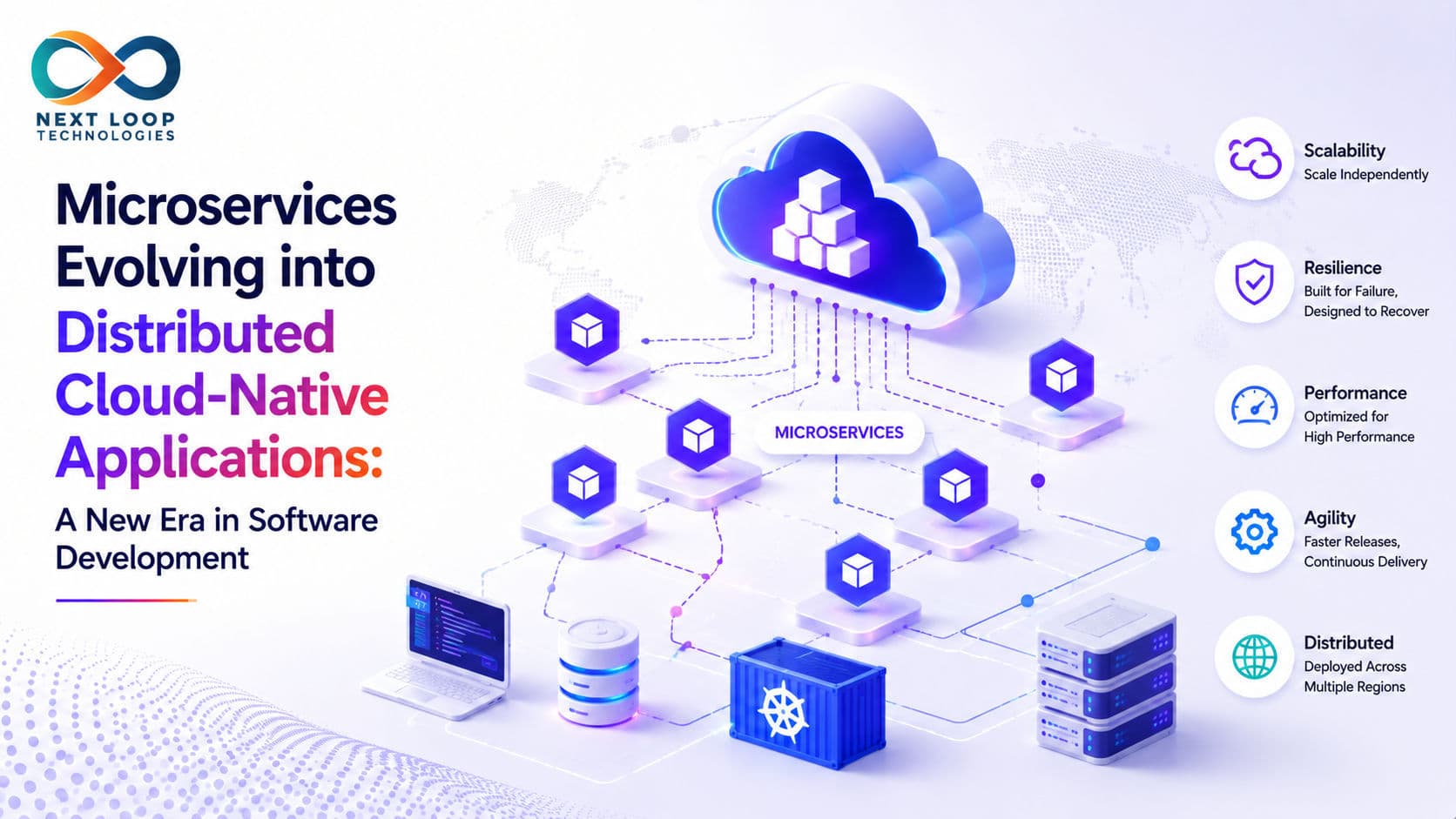
In today’s fast-paced digital landscape, businesses need software systems that can scale efficiently, remain reliable, and adapt to changing customer expectations. Microservices architecture and cloud-native technologies help organizations build applications that are more flexible and easier to evolve.
When combined, these approaches enable businesses to develop, deploy, and manage distributed applications using independent services, cloud infrastructure, and automated delivery processes.
In this guide, we’ll explore what microservices and cloud-native applications are, how they work together, their business benefits, and the considerations involved in adopting this architecture.
What Are Microservices?
Microservices are an architectural approach in which an application is organized into small, independently deployable services. Each service focuses on a specific business capability and communicates with other services through well-defined interfaces, commonly APIs or messaging systems.
For example, an e-commerce platform might have separate services for product catalogs, payments, inventory, and order management.
Key Characteristics of Microservices Architecture
- Independent deployment: Teams can update individual services without redeploying the entire application, provided service contracts remain compatible.
- Business-focused design: Each service handles a specific business capability.
- Independent scaling: Services can be scaled according to their individual workloads.
- Technology flexibility: Different services may use different technologies when there is a clear operational benefit.
- Fault isolation: Failures can be contained when appropriate resilience mechanisms are in place.
Microservices can improve flexibility, but they also introduce complexity in communication, monitoring, testing, and operational management.
What Are Cloud-Native Applications?
Cloud-native applications are designed to take advantage of cloud environments, automation, and modern infrastructure practices. They commonly use technologies such as containers, orchestration platforms, managed cloud services, and serverless computing.
Rather than simply moving existing software to a cloud server, cloud-native development focuses on building and operating applications that can take advantage of cloud capabilities.
Key Benefits of Cloud-Native Applications
1. Scalability
Cloud-native applications can scale resources according to workload demands. With suitable architecture and configuration, businesses can handle traffic spikes without permanently maintaining infrastructure for peak capacity.
2. Resilience and Reliability
Health checks, automated recovery, redundancy, and distributed deployment can help applications recover from certain failures. Reliability still depends on how the system is designed and operated.
3. Faster Software Delivery
Automated build, testing, and deployment pipelines can help teams release changes more frequently and consistently.
4. Infrastructure Flexibility
Cloud platforms provide access to different compute, storage, networking, and managed services, allowing businesses to choose infrastructure that fits their requirements.
Technologies That Support Cloud-Native Development
Common technologies and practices include:
- Containers: Package applications and their dependencies into portable units.
- Kubernetes: Automate the deployment, scaling, and management of containerized workloads.
- Serverless computing: Run code or services without directly managing the underlying server infrastructure.
- CI/CD pipelines: Automate software integration, testing, and delivery.
- Observability tools: Help teams monitor application health, performance, logs, and distributed requests.
The right technology stack depends on the application's complexity, team capabilities, security needs, and operational budget.
How Are Microservices Evolving Into Distributed Cloud-Native Applications?
Microservices and cloud-native development are complementary approaches. Microservices organize application functionality into services, while cloud-native practices provide ways to deploy, scale, automate, and operate those services across cloud infrastructure.
Together, they can support distributed applications that respond more effectively to changing business requirements.
1. Independently Scalable Services
In a monolithic application, scaling may require allocating more resources to the application as a whole. With microservices, individual services can often scale independently based on demand.
For example, an online retailer might need additional capacity for its product catalog during a major sale without scaling every other component by the same amount.
2. Autonomous Service Development
Teams can develop and deploy services independently when ownership, interfaces, and dependencies are clearly defined. This can help organizations improve development workflows and reduce coordination overhead.
However, splitting services too aggressively can increase network communication and operational complexity. Service boundaries should reflect meaningful business capabilities.
3. Distributed Resilience
Cloud-native applications can distribute workloads across multiple instances, availability zones, or regions where appropriate. Techniques such as timeouts, retries, circuit breakers, and graceful degradation can help prevent certain failures from spreading across the system.
Distribution alone does not guarantee resilience; dependencies and failure scenarios must be planned and tested.
4. Automation and Continuous Delivery
Container platforms and CI/CD pipelines can automate testing, deployment, configuration, and recovery tasks. This helps teams deliver changes consistently while reducing manual operational work.
Automated rollbacks, staged releases, and deployment health checks can further reduce release risk.
5. Improved Resource Utilization
Cloud infrastructure allows businesses to adjust resources according to application needs. Autoscaling and managed services may improve utilization, although cloud costs can rise if workloads, network traffic, storage, and service dependencies are not monitored carefully.
6. Distributed Data and Communication
Distributed cloud-native applications often use APIs, asynchronous messaging, and event-driven communication to connect services. These patterns can improve flexibility but require careful handling of data consistency, message delivery, service failures, and network latency.
Why Should Businesses Adopt Distributed Cloud-Native Applications?
For businesses with suitable workloads, distributed cloud-native architecture can support faster delivery, improved scalability, and greater flexibility.
Faster Time to Market
Independent service development and automated delivery pipelines can help teams release features without coordinating every change across a single large application.
More Responsive User Experiences
Services can be scaled and optimized according to workload requirements, helping businesses maintain performance during periods of high demand.
Greater Flexibility for Business Growth
Cloud infrastructure can support expansion into new markets and changing workloads without requiring businesses to manage all infrastructure capacity themselves.
Increased Innovation
Modular systems can allow teams to experiment with new technologies and improve specific business capabilities without rebuilding the entire application.
Better Alignment Between Technology and Business Needs
When services map to clear business functions, teams can prioritize improvements according to customer needs, operational bottlenecks, and business objectives.
These benefits are not automatic. Microservices may be unnecessary for smaller applications or teams that would benefit more from a well-structured monolith.
What Challenges Should Businesses Consider?
Before adopting a distributed cloud-native architecture, organizations should evaluate several technical and operational challenges.
Operational Complexity
Managing multiple services requires effective deployment automation, monitoring, logging, security controls, and incident response processes.
Network Latency and Service Dependencies
Communication between services introduces network delays and potential failure points. Teams need clear service contracts, timeouts, and appropriate failure-handling strategies.
Data Consistency
When data is distributed across services, maintaining consistency can be more complicated than in a single database. Data ownership and transaction requirements should be planned carefully.
Security and Access Management
Every service and communication path can introduce security considerations. Strong identity controls, least-privilege access, encryption, secrets management, and regular security testing are important.
Cloud Cost Management
Additional services, observability systems, network traffic, and orchestration infrastructure can increase operating costs. Businesses should monitor resource usage and evaluate whether the architecture provides sufficient value.
How Can Businesses Transition to Cloud-Native Architecture?
A phased migration can help organizations reduce risk and identify the most valuable opportunities for modernization.
Step 1: Assess the Existing Application
Review the current architecture, performance limitations, dependencies, deployment process, and business requirements.
Step 2: Identify Suitable Service Boundaries
Determine which business capabilities would benefit from independent deployment or scaling. Avoid splitting components into microservices without a clear reason.
Step 3: Select the Right Cloud Platform and Tools
Evaluate cloud providers, container technologies, managed services, networking, security, and monitoring tools based on project requirements.
Step 4: Modernize Incrementally
Start with a well-defined component or workload, validate the approach, and expand gradually. A complete rewrite is not always necessary.
Step 5: Automate Testing and Deployment
Introduce CI/CD pipelines, automated tests, infrastructure management, and appropriate deployment safeguards.
Step 6: Monitor Performance and Costs
Track availability, response times, error rates, infrastructure utilization, and operating costs to assess whether the architecture is delivering the expected results.
How Cloud Computing Solutions Support Distributed Cloud-Native Applications
Building and operating distributed cloud-native applications requires more than dividing software into smaller services. Businesses also need suitable cloud infrastructure, secure deployment environments, reliable networking, monitoring, and resource management.
Cloud computing solutions can help organizations select and configure cloud resources, modernize infrastructure, improve scalability, and support the deployment of applications in cloud environments. The right approach depends on existing systems, performance requirements, security obligations, and long-term business goals.
At Nextloop Technologies, businesses can explore cloud computing solutions to learn more about cloud technologies and approaches that can support their digital transformation initiatives.
Whether an organization is planning a cloud migration, modernizing its application infrastructure, or preparing workloads for greater scalability, a structured cloud strategy can help align infrastructure decisions with operational needs. Architecture planning should also account for resilience, security, cost management, and ongoing maintenance.
Conclusion: The Future of Distributed Cloud-Native Applications
Microservices and cloud-native technologies are helping businesses build applications that can evolve with changing requirements. By combining modular service design with automation, cloud infrastructure, and effective monitoring, organizations can improve software delivery and scale suitable workloads more independently.
However, distributed architectures also introduce challenges involving complexity, security, data consistency, and operating costs. Businesses should evaluate these trade-offs before deciding whether microservices and cloud-native development are appropriate for their needs.
Ready to explore cloud modernization for your business? Contact Nextloop Technologies to discuss your software and cloud infrastructure goals.